

The Shopify platform is not just a CMS for building eCommerce stores. It is an intelligent and adaptive engine powered by real-time data, autonomous decisioning, and customer-oriented models. The transition from a manual workflow to AI-led personalization has become the key foundation for driving revenue, customer loyalty, and operational excellence. As the market continues to evolve with remarkable eCommerce features, brands that implement AI-driven Shopify customization will outperform competitors.
This blog provides a clear picture of how AI in 2026 redefines personalization, UX, customer experience design, and how brands can leverage this emerging technology for exceptional growth.
Why Every Shopify Brand Must Go AI-First by 2026
The move toward AI-led experiences is not a trend but an infrastructure shift.
1. Shopify AI Acquisitions Rapid Innovation
Shopify’s recent AI-oriented acquisitions optimise its native search, personalisation, and predictive discovery functionality. With such technologies fully embedded in the platform, merchants can provide sophisticated experiences without complex custom engineering. This implementation of AI in the Shopify store makes the data flow less fragmented, and it takes intelligence closer to the main Shopify stack.
2. Emergence of Autonomous Shopping Agents
The next category is the development of AI-based shopping agents, bots, which can search, compare, and buy independently. Shopify stores need to be streamlined with organised product information, semantic search and articulated pricing cues so the AI agents can analyse and purchase effectively. This change highlights the importance of AI-ready UX and smart discovery.
3. Customer Confidence in AI-Assisted Purchasing
Customers are becoming more confident in AI-based suggestions, virtual assistants, and purchase guides. Due to the increasing integration of AI into the daily lives of digital ecosystems such as smartphones, OTT applications, and banking, consumers will expect the same level of online store intelligence. This comfort enhances the conversion rates of AI-based recommendations and personalized shopping.
4. Multimodal AI becomes Standard
As multimodal AI models become widespread, Shopify stores will be able to utilize image search, video-guided products, voice-guided, and provide more conversational commerce. These AI Shopify personalization capabilities combine various inputs, such as text, image, and audio, to understand customer intent more precisely and create more intuitive and engaging experiences.
5. Reduced Operational Costs by AI Automation
AI drastically reduces operational overheads through enhanced inventory forecasting, replenishment cycles, dynamic pricing, and optimizing fulfillment. For Shopify merchants, an AI-powered shopping experience will result in fewer stockouts, enhanced demand planning, and higher margins. In 2026, AI will transition from a strategic cost driver to a tool to improve logistics.
To explore how immersive commerce is evolving alongside AI, check the in-depth discussion on “How Shopify is setting the future of AR shopping.”
Benefits of AI-Driven Technologies for Shopify Stores

Shopify stores powered by AI technologies offer numerous benefits, including a competitive edge, increased sales, and brand value. Some major benefits are discussed.
1. Personalized Recommendations
AI models use a combination of browsing history, purchase history, session intent, or micro-interactions to provide product recommendations. According to Contentful, 83% of consumers are likely to purchase from a store that suggests products they have recently browsed. Having AI for Shopify product recommendations, stores can dynamically update their PDPs, collections, and homepages to increase AOV and reduce decision fatigue through hyper-personalization in eCommerce.
2. Inventory Management Forecasting
The AI systems predict demand spikes, seasonality, and SKU-level velocity to avoid stockouts or overstocking. These insights help Shopify brands maintain optimal inventory, lower carrying costs, and ensure timely fulfillment. When AI is used in Shopify stores, predictive inventory becomes a valuable operating benefit that promotes conversion and reduces lost revenue.
3. AI Chatbots for Support
AI chatbots already accept real-time queries, order updates, product questions, and returns – providing real-time, human-like customer service throughout the customer journey. These bots bring value to Shopify stores by serving customers through a context-aware 24/7 support. They also help create a smooth, intelligent shopping experience that minimizes the load on support staff and increases customer satisfaction. This is becoming a major AI Shopify trend of 2026.
4. Automated Marketing and Ad Targeting
AI analyzes customer segments, behavioral cues, and purchase interest to create campaigns and optimize performance. Performing customization and using high-tech Shopify AI personalization tools, stores deliver hyper-targeted messages, dynamic offers, and AI-generated creatives. This saves on marketing efforts, improves ROAS, and customers are presented with the right message at the right time.
5. Fraud Detection
AI models identify unusual transactions and suspicious user actions as well as high-risk payment patterns. Shopify merchants can minimize chargebacks and secure revenue by integrating historical data with pattern-based detection. Monitoring can enhance compliance, security, and trust, which are key elements for the Future of AI in eCommerce where digital trust directly impacts conversion.
Tips for Shopify Customization and Customer Experience Design
Tip 1: Treat AI as a Co-Pilot, Not a Plugin
To win in 2026, you must break free from the idea of “installing an AI app” and reconsider the entire architecture of your store. AI is to serve as a strategic co-pilot and be integrated in merchandising, UX flows, content, and customer support. It offers compounding returns in relevance, speed, and operational efficiency when used as an intelligence layer rather than a tactical add-on.
Tip 2: Implement Reinforcement Learning in Merchandising
Shopify merchants can increase revenue by a huge percentage by allowing reinforcement learning models to optimize collection layouts, product sequencing, and bundle logic. The system does not have fixed rules; instead, it adjusts placements according to real-time performance indicators, including clicks, conversions, session depth, and margin impact. As time progresses, the algorithm finds the mixes that bring the best value per user and provides a smarter/more profitable merchandising approach.
Tip 3: Build Dynamic Content Blocks Using AI
In a world where intent, seasonality, price elasticity, and inventory demand are changing every hour, content can not remain static any longer. The AI-led content generation will make it possible to dynamically modify banners, PDP copy, offers, and CTAs that change according to each session. These smart content blocks are sure to deliver the appropriate message, and AI customer experience design becomes more personalized, leading to a major surge in revenue.
Tip 4: Invest in Intelligent Search Early
Those brands that embrace intelligent search as early as possible have always dominated the conversion, relevance, and AOV of their peers. Advanced systems that use AI eCommerce search and personalized recommendations know the intent of the shopper instead of simply matching keywords. Through observation of behavioral patterns, synonyms, and past experiences with the user, intelligent search directs the user to products they are actually looking to buy.
Future Trends of AI-Native Shopify Store
AI-native Shopify stores in 2026 and beyond will operate on autonomous optimization, hyper-personalization, voice commerce, and predictive operations. Brands that modernize their tech stack early and hire Shopify developers who understand AI-first architecture will gain a significant competitive edge in this eCommerce landscape.
| Trend Area | Description |
| Hyper-personalized Stores | Stores will adapt layouts, product ordering, bundles, and offers in real time |
| AI-powered Search & Discovery | Advanced search systems using AI interpret shopper intent, correct typos, understand semantics, and surface product recommendations |
| Voice & Conversational Commerce | Integration of voice assistants and AI agents will let customers browse, search, and transact via voice or chat |
| Predictive Operations & Inventory Intelligence | AI will forecast demand, dynamically manage stocks, and optimize supply-chain or fulfillment workflows to reduce overstocking or stockouts. |
Most Common Mistakes eCommerce Brands Make in 2026
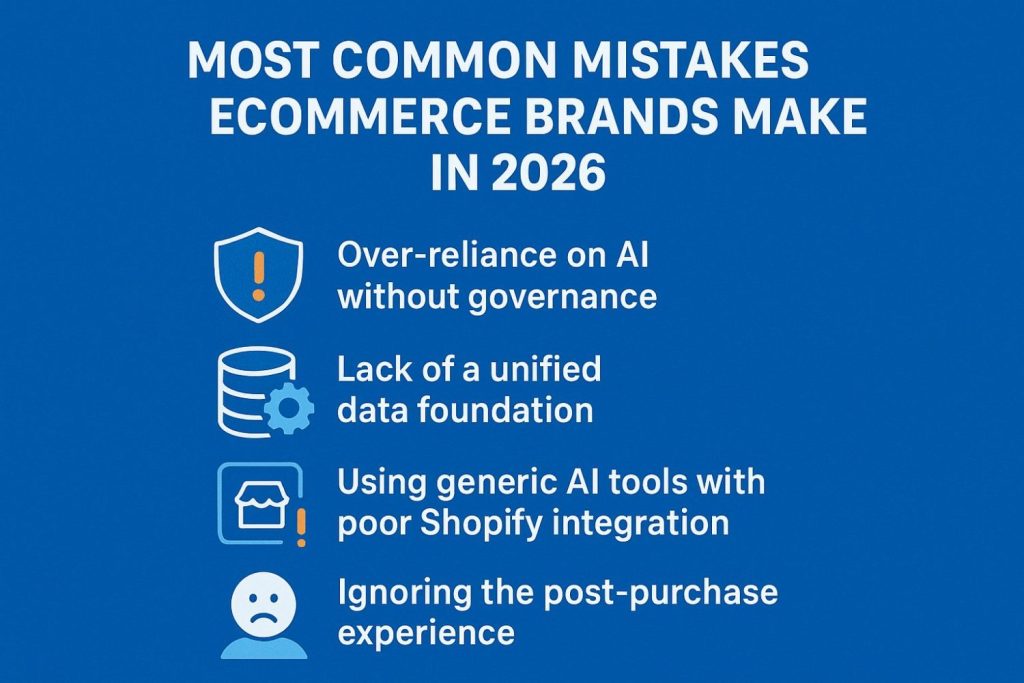
1. Over-Relying on AI Without Strategy
Brands rely on AI tools but lack governance, training, data quality, and strategic oversight.
2. No Unified Customer Data Layer
Customer information remains scattered across apps, hindering true personalization and AI decision-making.
3. Using Generic AI Tools Not Built for Shopify
Generic platforms fail to understand Shopify-specific schemas, product structures, and workflows.
4. Ignoring the Post-Purchase Experience
Brands focus on acquisition but neglect tracking, returns, support automation, and loyalty journeys.
Conclusion
2026 indicates the real shift to intelligent commerce, where AI will shape every aspect of the Shopify customer journey, from search to recommendations, content, support, and ultimately, operations. Brands that incorporate AI as a fundamental capability of their platform, rather than as a feature, will provide faster, smarter, more personalized experiences that lead to sustainable growth. Working with experts of Shopify Development Services ensures your store is architected for an AI-first future, which will enable you to thrive and outperform the competition in the new landscape of eCommerce.