

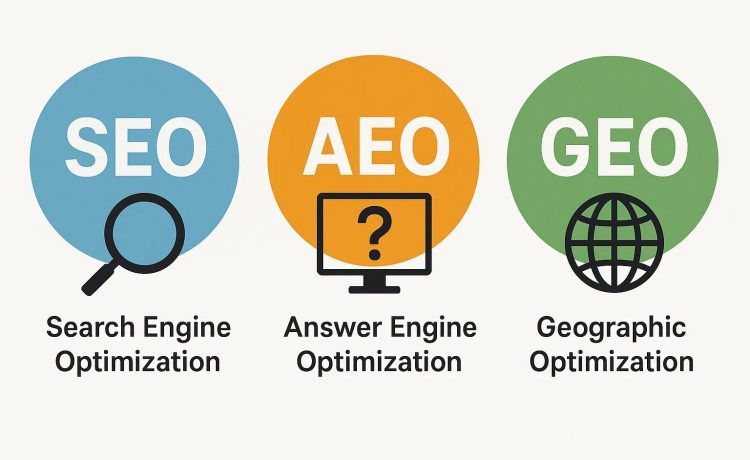
The way people search for information is changing rapidly. A decade ago, Search Engine Optimization (SEO) was the only strategy businesses needed to ensure online visibility. But today, search has evolved into something more dynamic-people no longer just “search,” they expect instant answers, AI-generated insights, and even voice-driven results.
This shift has given rise to two new optimization strategies: Answer Engine Optimization (AEO) and Generative Engine Optimization (GEO). Together, SEO, AEO, and GEO are reshaping how businesses show up online.
In this guide, we’ll break down what each of these strategies means, why they matter, how they overlap, and which one your business should prioritize in 2025.
What is SEO?
Search Engine Optimization (SEO) is the process of improving a website’s visibility in search engine results pages (SERPs). It helps businesses attract more organic traffic by aligning content with what users are searching for.
The concept has been around for over two decades, but continues to evolve. Today, SEO is no longer about keyword stuffing-it’s about creating valuable, trustworthy, and technically sound content that both humans and search engines understand.
Core Components of SEO
SEO consists of several pillars:
- On-Page SEO
- Optimizing titles, meta descriptions, and headings.
- Writing semantic content that answers user intent.
- Using schema markup to structure data.
- Technical SEO
- Improving site speed and mobile responsiveness.
- Fixing crawl errors and ensuring proper indexing.
- Enhancing security with HTTPS.
- Off-Page SEO
- Building backlinks from authoritative sites.
- Improving brand trust through mentions and digital PR.
- Engaging in reputation management.
- Content SEO
- Creating long-form, E-E-A-T-compliant content.
- Internal linking is used for navigation and topical relevance.
- Publishing blogs, videos, and infographics.
Example: If a fitness brand writes a blog on “best home workouts,” SEO ensures that the article ranks on Google when users search for those keywords.
Why SEO Still Matters?
Businesses that fail to plan their SEO migration toward newer models like AEO and GEO risk losing visibility.
Some claim that SEO is dying with the rise of AI, but the truth is-it’s evolving. SEO is still relevant in 2025 because:
- People still use search engines daily-Google handles over 8.5 billion searches per day.
- SEO builds long-term brand visibility and trust, unlike paid ads that disappear once the budget runs out.
- SEO acts as the foundation for both AEO and GEO strategies.
Without SEO, your site won’t have the technical strength or content authority to appear in AI-generated results or answer engines.
What is AEO?
Answer Engine Optimization (AEO) is about optimizing content to appear as direct answers in search engines and voice assistants. Unlike SEO, which focuses on rankings, AEO focuses on visibility in zero-click searches like featured snippets, knowledge panels, and voice search answers.
Example: If you ask Google, “What is a calorie counter app?” and it shows a box with a short definition, that’s the result of AEO.
Key Tactics for AEO
- Featured Snippets Optimization
- Write content that answers “what,” “how,” and “why” questions directly.
- Use bullet points, tables, or concise definitions.
- Schema Markup
- Add structured data so search engines can identify FAQs, how-tos, and product details.
- Add structured data so search engines can identify FAQs, how-tos, and product details.
- Voice Search Optimization
- Optimize content for conversational queries.
- Example: Instead of “calorie counter benefits,” optimize for “What are the benefits of using a calorie counter app?”
- Zero-Click Search Awareness
- Accept that some users won’t click through.
- Instead, focus on branding within the snippet itself.
Why AEO is Rising?
The demand for quick answers is driving the rise of AEO. According to industry studies:
- 50% of all online searches will be voice-based by 2025.
- 65% of Google searches now end without a click, thanks to featured snippets and instant answers.
This means that if your content isn’t optimized for AEO, your competitors will own those high-visibility spaces.
What is GEO?
Generative Engine Optimization (GEO) is the newest form of optimization, designed for the AI-first era of search. Instead of delivering links or snippets, AI tools like ChatGPT, Bing Copilot, and Google’s Search Generative Experience (SGE) generate entire answers by pulling information from multiple sources.
GEO ensures that your brand gets cited by AI systems in these generated responses.
Example: If someone asks an AI chatbot, “What are the best fitness tracking apps?” and the AI mentions your brand as a source, you’ve successfully leveraged GEO.
GEO Strategies Include
- Semantic Content Creation
- Write deeply structured content with headings, FAQs, and topic clustering.
- Helps AI understand and repurpose your text.
- AI Citations Building
- Build topical authority so AI tools recognize your site as a trusted reference.
- Build topical authority so AI tools recognize your site as a trusted reference.
- Content Depth & Authority
- GEO favors research-backed, expert-written content over short blogs.
- GEO favors research-backed, expert-written content over short blogs.
- Multimedia Optimization
- AI pulls from text, images, and video, so diversify your content formats.
Why GEO Matters in 2025?
Generative AI is already influencing digital marketing and search behavior. GEO matters because:
- AI-driven platforms are replacing traditional search for many users.
- Brands cited within AI-generated answers gain instant credibility.
- GEO is becoming the future-proof strategy for search visibility.
In short, GEO is where search is headed, and businesses that adapt early will stay ahead of the curve.
SEO vs AEO vs GEO: A Comparison
Here’s a quick table to understand the differences:
| Aspect | SEO | AEO | GEO |
| Focus | Ranking on search engines | Featured snippets & voice answers | AI-generated responses |
| User Intent | Click-through traffic | Quick answers | Conversational, detailed insights |
| Tech Involvement | Keywords, schema, backlinks | Schema, FAQ, structured data | AI citations, semantic depth |
| Best For | Long-term visibility | Instant visibility in SERPs | Future-proofing in AI-driven search |
Where They Overlap?
Despite differences, SEO, AEO, and GEO share some common ground:
- It all depends on high-quality, trustworthy content.
- Technical SEO, like schema markup, benefits AEO and GEO alike.
- Understanding user intent is the foundation for success across all three.
How SEO, AEO, and GEO Work Together?
Think of these strategies as a ladder of visibility:
- SEO builds the foundation. Without it, your site won’t get discovered.
- AEO positions your content for quick, direct answers.
- GEO ensures AI-generated engines cite your content in future queries.
A business that applies all three gains visibility in traditional search, voice search, and AI-driven platforms.
Which Strategy Should You Prioritize?
The answer depends on your goals:
- Small businesses/new websites → Start with SEO for traffic.
- Brands in competitive markets → Add AEO to win featured snippets.
- Future-focused companies → Invest in GEO to appear in AI results.
In 2025, the best approach is not choosing one-it’s integrating all three.
Best Practices for Businesses in 2025
To thrive in this evolving landscape:
- Invest in Structured Data – Schema markup is critical.
- Create Conversational Content – Helps with voice search optimization and GEO.
- Build Topical Authority – Publish in-depth guides that answer multiple related questions.
- Monitor AI Citations – Track how often your brand appears in AI-generated answers.
- Stay Updated – SEO, AEO, and GEO evolve constantly, so adapt your strategy regularly.
Conclusion
The world of search has evolved far beyond the days when ranking on the first page of Google was the ultimate goal. Today, visibility means much more than showing up in a list of blue links—it’s about being discovered, featured, and trusted in the places where people (and AI systems) are looking for answers.
SEO still plays the foundation role by making sure your website is structured, optimized, and visible in traditional search results. Without it, you’re not even in the game.
AEO (Answer Engine Optimization) goes a step further. It positions your business as the instant solution by targeting voice queries, featured snippets, and zero-click searches. This is how you meet customers in the exact moment of their need.
GEO (Generative Engine Optimization) takes it into the future. It ensures your brand is recognized and cited by AI-driven platforms like ChatGPT, Google SGE, and other generative engines. In other words, GEO helps your business become part of the conversation AI has with your audience.
When these three strategies work in harmony, businesses unlock a powerful advantage. They don’t just capture attention-they build trust, authority, and long-term influence in an AI-first world.
Looking ahead to 2025 and beyond, the companies that thrive will be those that stop treating SEO, AEO, and GEO as separate silos. Instead, they’ll view them as interconnected layers of digital strategy. The search landscape is moving fast, but one thing is clear: the future is AI-powered, answer-focused, and generative by design.