

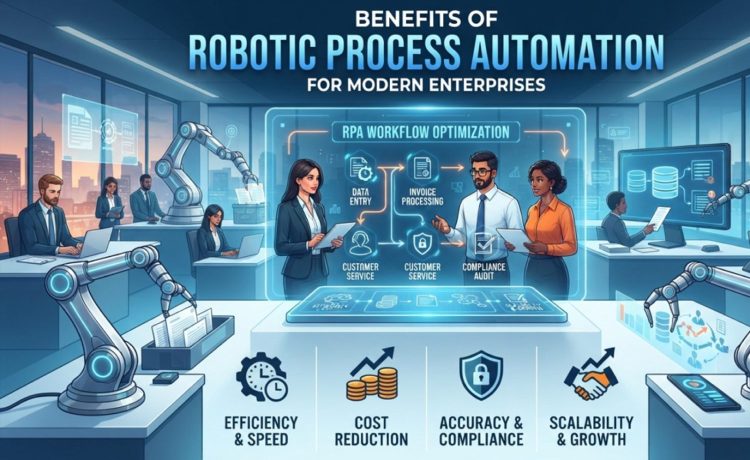
Do you want to know the top benefits of Robotic Process Automation for Modern Enterprises? If yes, then read our detailed blog. It contains all the key benefits that your business will get from robotic process automation. Let’s explore.
What is RPA (Robotic Process Automation)?
Robotic Process Automation (RPA) is a type of technology that employs software robots to automate repetitive, rule-based, transactional processes and tasks.
These robots are programmed to act the same way humans would to get the desired result right.
This technology is used to help organisations automate processes to complete quicker and reduce errors and inefficiencies.
RPA allows human resources to focus on higher level tasks, while robotic automation takes care of tedious, rule-based work to help grow the business.
The RPA solutions are usually highly configurable and often easily integrated into existing systems to add speed to operations while making it easier to scale up.
You should consider this technology if you need greater control and scalability while meeting the demands of your industry or business.
Industries That Can Benefit From RPA
Modern-day businesses strive to increase their chances of being more cost-efficient while meeting the demands of the market.
However, just like with any other technology, automation has to be implemented thoughtfully to ensure that it fits the specific needs of the business.
RPA is an excellent tool for most industries that want to invest in a software solution that is easily scalable to fit their needs.
It provides better control over processes, and can be implemented fast enough to gain experience quickly and see a return on investment.
Some of the industries that have the most significant potential to benefit from RPA include:
Banking
Processes such as account management, transaction processing, fraud detection, and compliance can become fully automated to improve customer service.
Manufacturing
Inventory management becomes seamless, production planning is more efficient, and quality control is easier to achieve.
Insurance
Insurance companies can increase efficiency while reducing errors during the binding process, processing claims, and ensuring compliance.
Healthcare
Automation can help to increase data accuracy during the recording and billing process as well as with scheduling patients.
Logistics And Supply Chain
Order processing, inventory management, and logistics are all automated to provide faster delivery while minimizing costs.
Life Sciences
Compliance, data integrity, and processes involved in clinical trials are made seamless by automation.
Top Benefits of Robotic Process Automation
RPA serves as the foundation for Intelligent Automation (IA) which enables software bots to leverage solutions such as Natural Language Processing (NLP) and Machine Learning (ML).
This results in faster and more efficient processes which are able to adapt to complex real-world environments. Intelligent Automation yields multiple advantages, including
Increased Productivity
Compared to manual data entry, Intelligent Automation bots work exponentially faster while ensuring round-the-clock operations.
Thus, they enable organizations to scale core processes, even when the human workforce is asleep.
This makes RPA especially suitable for high-volume and high-impact processes such as customer onboarding.
For instance, one of America’s largest insurance companies automated their customer onboarding process using the Smart Bots, reducing their Full Time Equivalent by 60%.
Stress-Free Regulatory Compliance
Robotic process automation is extremely useful for businesses which operate in highly regulated industries like healthcare, insurance, and finance.
For instance, when bots undertake reconciliation and control processes, the likelihood of errors is significantly reduced compared to humans
Healthcare provider Kane Wound Care leverages AI powered bots to code patient documentation and generate invoices.
Compared to manual processes, intelligent automation resulted in a 90% improvement in coding accuracy for Kane Wound Care.
Faster Implementation
One of the most compelling advantages of RPA automation bots over traditional methods is the quick implementation time.
Compared to bots which require extensive coding to fit existing systems or require new systems to be designed and built from scratch.
Smart Bots can be up and running in weeks rather than months or years.
Smart Bots can be implemented in weeks with minimal disruption to the existing digital ecosystem as the bots are trained to operate on systems already in use.
The quick start program can provide an intelligent automation Bot for your most critical business processes within 4 weeks.
Improved Customer Experience
Updating data management systems used for managing customers manually is time-consuming.
RPA connects systems, allowing near-real-time updates and hence providing better customer experiences.
On top of that, software bots make it possible to complete manual processes more efficiently, thus enabling workers to concentrate on providing improved customer experiences.
Fastest-growing banks leverage the power of RPA Bots to automate the processes involved in trade financing and close their letters of credit 70% faster than before.
This leads to happier customers and business growth.
Proposals Streamlined
For risk management industries like insurance companies, it is necessary to review a new proposal in order to determine whether they can accept a customer, policy, or partnership.
One of the largest insurance companies had to hire 25 people working full-time.
In order to check proposals and applications through manual means and go through a tough process of comparing new proposals with the internal database and customer documents.
But once this insurance company started using Smart Bots with built-in Computer Vision-based OCR technology everything changed.
They managed to automate the proposal processes and save 6,000 employee hours per month.
Accuracy
A robot process is not subject to tiredness or any mistakes; bots do not fail in any way; they are consistent and precise (if their governing principles are put into practice and updated to reflect changes).
Processes performed through automation with software bots have a much lower number of mistakes than human beings do.
Elimination of mistakes made in the course of high-volume operations means spending less time and funds on correction of errors.
More precise and efficient operation can also positively affect the experience of clients.
Process Security
RPA can create a series of cybersecurity layers within an organization’s processes.
First of all, RPA automation will help reduce the human contact with sensitive data (especially customer data), which means the elimination of any chances of accidental breaches.
Second of all, comprehensive logs provide an auditing trail of bot interaction with the data.
The use of RPA tools such as threshold alerts helps detect abnormal access and log out bots when necessary in order to protect from misuse.
Lastly, each RPA process has very strict parameters with automatic protection from bot actions that could jeopardize security.
Scalability in Business
One of the main features of the RPA systems is their scalability; this makes the businesses that utilize such systems scalable as well.
If properly applied, robots process any increases in workload without losing the pace of their activities.
The businesses can change the number of deployed robots according to the current workload.
It may refer either to an increase in workload, thus increasing the number of the robots to cope with it, or to a decrease in workload, which allows reducing the number of robots used.
Enhanced ROI
Productivity and efficiency improvements will lead organizations to get much done with little effort.
Software robots need no lunch breaks, no downtime, and maintain undivided attention at all times.
Automation of repetitive processes will help organizations cut down labor costs despite growing businesses and considering RPA deployment and management.
Furthermore, software robots will allow people in the organization to concentrate on those activities that need human intuition and understanding.
This will increase productivity in other important areas of the business and make the payback period for investments in automation shorter.
Easy Systems Integration
With proper configuration, RPA software will make system integration easy.
This enables non-technical business people to integrate, analyze, interpret, and use data on various platforms of the organizational network.
Therefore, it is clear that RPA can offer substantial competitive advantages to an organization. However, before such advantages can be realized, it is important that proper due diligence is conducted.
AI Compatibility
With AI, ML, IDP, and other cognitive RPA technologies, businesses go beyond robotic process automation through intelligent automation or agentic automation.
With artificial intelligence, automation becomes possible for unstructured data in the form of emails, PDFs, documents, and more.
AI gives intelligent decision making, and there is more end-to-end automation that results in better exception handling.
Conclusion
A growing number of businesses understand that without robotic automation, they cannot thrive in 2026.
The trend of robotic process automation ensures process improvement while reducing costs and increasing organizational efficiency.
It also facilitates increased compliance with regulatory requirements, and better customer service through more efficient operations, making it an essential component of enterprise growth.
Robotic process automation offers businesses across the world an opportunity to improve their operations by automating repetitive tasks and enabling them to increase their overall performance and productivity.